|
Size: 2823
Comment:
|
Size: 2813
Comment:
|
| Deletions are marked like this. | Additions are marked like this. |
| Line 9: | Line 9: |
| ||{{attachment:group_prior.png|DU15NET-Prior|frameless|width=1000 height=400}}|| | ||{{attachment:group_prior.png|DU15NET-Prior|width=1000 height=400}}|| |
A novel 15-network parcellation from fMRI data in 15 intensively sampled participants
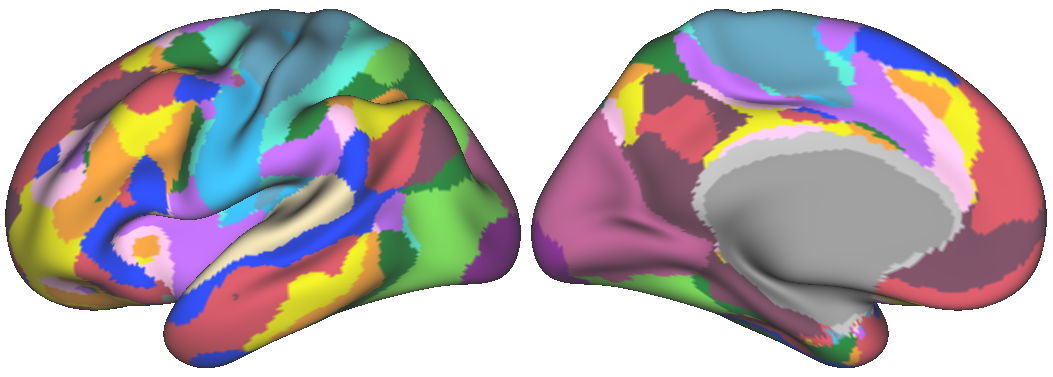
A novel 15-network parcellation was constructed by estimating networks from functional MRI (fMRI) data in 15 intensively sampled participants. In the present paper, we used the network estimates to better understand individual variation, spatial relations among networks, and their functional properties. The estimates were further used to construct atlases that we provide to the community as open resources. Five example atlases are shown. DU15NET-Prior: The 15-network group prior used in the MS-HBM model is made available as the DU15NET-Prior atlas. For many purposes this atlas can function and be utilized in group-based studies as an update to the prior “Yeo2011” atlases with refinements that reflect our current understanding of human cerebral network organization. The DU15NET-Prior utilizes the HCP data processed via their standard processing pipelines, and thus also has the benefit of being derived from data collected and registered with a commonly used set of pipelines. DU15NET-Consensus: A consensus map represents the assignment at each vertex to the most common network among the 15 individuals collected here. No vertex is left unassigned. The DU15NET-Consensus atlas differs from the DU15NET-Prior in that it reflects the idiosyncratic features and spatial registrations of the data from the present participants, including small regions that are absent in the group-averaged estimates. For example, there is a clear representation of the SAL / PMN network in medial prefrontal cortex. DU15NET-Agree53per: This agreement map is thresholded to leave only vertices with agreement across participants of n ≥ 8 (53%). The agreement atlases may be most useful when the goal is to construct regions-of-interest that have a high probability of being in one network and not another, in situations where it is appropriate to have regions that cover a portion of the cerebral cortex not the cortex in its entirety. DU15NET-Agree80per: This agreement map is thresholded to leave only vertices with agreement across participants of n ≥ 12 (80%). DU15NET-AgreeProb: The final provided atlas represents the probability at each vertex that, within the present 15 participant sample, the same network is assigned across individuals.
|