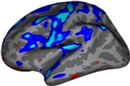
|
Size: 871
Comment:
|
Size: 1923
Comment:
|
| Deletions are marked like this. | Additions are marked like this. |
| Line 8: | Line 8: |
| === Stages === 1. From a freesurfer surface file (primarily ?h.pial, but ?.white or other surface files are possible), an 'outer surface' surface file is created, call ?h.outer-pial, which is basically a 'shrink-wrapped', or 'enveloped', version of the (pial) input. It is created either by morphological closing operation which operates on a volume created using mris_fill from the input (pial) surface file. Altneratively, a shrink-wrap utility (mris_shrinkwrap) could be used to create the outer-surface file. 1. Once the outer-surface file is available, then the local gyrification measurements are calculated for each vertex of the outer-surface. To do this, circular regions of interest are defined for each vertex on the outer-surface, and the corresponding areas of each ROI are found on the pial surface. Finally, the local gyrification index (lGI) values are calculated at each pial vertex point, and a scalar file is output (used in a similar manner as a 'thickness' scalar file). === I/O === |
|
| Line 9: | Line 14: |
| || ?h.pial || || ?h.outer-pial || || ?h.outer-pial || || || || || || || || || || || || || || || |
|| ?h.pial || mris_fill || ?h.pial.mgz || || ?h.pial.mgz || make_outer_surface || ?h.outer-pial || || ?h.outer-pial || mris_compute_lgi || ?h.lgi_pial || |
| Line 15: | Line 18: |
| == Usage == TBD |
Local Gyrification Index (LGI)
Overview
Gyrification index is a metric that quantifies the amount of cortex buried within the sulcal folds as compared with the amount of cortex on the outer visible cortex. A cortex with extensive folding has a large gyrification index, whereas a cortex with limited folding has a small gyrification index. The method to be incorporated into Freesurfer is based on that of Marie Schaer, [http://ltswww.epfl.ch/~schaer/Schaer_TMI_accepted.pdf "A Surface-based Approach to Quantify Local Cortical Gyrification"], which computes local measurements of gyrification at thousands of points over the whole cortical surface.
Processing Stream
Stages
- From a freesurfer surface file (primarily ?h.pial, but ?.white or other surface files are possible), an 'outer surface' surface file is created, call ?h.outer-pial, which is basically a 'shrink-wrapped', or 'enveloped', version of the (pial) input. It is created either by morphological closing operation which operates on a volume created using mris_fill from the input (pial) surface file. Altneratively, a shrink-wrap utility (mris_shrinkwrap) could be used to create the outer-surface file.
- Once the outer-surface file is available, then the local gyrification measurements are calculated for each vertex of the outer-surface. To do this, circular regions of interest are defined for each vertex on the outer-surface, and the corresponding areas of each ROI are found on the pial surface. Finally, the local gyrification index (lGI) values are calculated at each pial vertex point, and a scalar file is output (used in a similar manner as a 'thickness' scalar file).
I/O
Input |
Process |
Output |
?h.pial |
mris_fill |
?h.pial.mgz |
?h.pial.mgz |
make_outer_surface |
?h.outer-pial |
?h.outer-pial |
mris_compute_lgi |
?h.lgi_pial |