|
Size: 6137
Comment:
|
Size: 8275
Comment:
|
| Deletions are marked like this. | Additions are marked like this. |
| Line 1: | Line 1: |
| This wiki page describes how to compute the difference map in cortical thickness from two repeated scans of the same subject, and how to compute the overall statistics from a group of such repeated scans. This computation is needed in validation studies of cortical thickness measurement using FreeSurfer. |
= Thickness reproducibility = |
| Line 5: | Line 3: |
| In the following, we assume each subject has two repeated scans, for example, 1001 and 1001a for the first subject. We also assume that recon-all has been completed for all the data. The thickness reliability study will consist of the following steps. |
''Author: Xiao Han (see also: XiaoNotes)'' ---- This wiki page describes how to compute the difference map of cortical thickness from two repeated scans of the same subject, and how to compute the overall statistics from a group of such repeated scans. This computation is needed in [[http://www.nmr.mgh.harvard.edu/~fischl/reprints/Han_NeuroImage_2006_thickness_reliability.pdf|validation studies of cortical thickness measurement]] using !FreeSurfer. |
| Line 9: | Line 9: |
| Step 1. Compute the linear alignment between the two repeated scans of each subject. Taking 1001 and 1001a as example, we use FLIRT for the linear registration, and the command line is: "fsl_rigid_register -i $SUBJECTS_DIR/1001/mri/orig.mgz -r $SUBJECTS_DIR/1001a/mri/orig.mgz -o $SUBJECTS_DIR/1001a/mri/orig_o_to_a.mgz -dof 9 -cost corratio -ltamat $SUBJECTS_DIR/1001/mri/transforms/1001_to_1001a.lta". "1001_to_1001a.lta" is the registration file that will be used later. |
'''Note: this method is used when the two scans are processed cross sectionally (individually). It is recommended to use the [[LongitudinalProcessing|longitudinal stream]] instead.''' |
| Line 15: | Line 11: |
| Step 2. Compute the thickness difference map for each subject. Taking again 1001 as an example, the command line is "mris_thickness_diff -xform $SUBJECTS_DIR/1001/mri/transforms/1001_to_1001a.lta -src_type curv -trg_type curv -out $SUBJECTS_DIR/1001/surf/lh.thickness_diff.w -nsmooth 0 -abs -S 1001 -L $SUBJECTS_DIR/1001/surf/lh_thickness_diff.log $SUBJECTS_DIR/1001/surf/lh.white $SUBJECTS_DIR/1001/surf/lh.thickness $SUBJECTS_DIR/1001a/surf/lh.white $SUBJECTS_DIR/1001a/surf/lh.thickness". |
In the following, we assume that each subject has two repeated scans, for example, 1001 and 1001a are two scans for the first subject. We also assume that recon-all has been completed for all the data. The thickness reliability study will consist of the following 4 steps. |
| Line 20: | Line 13: |
| The above need be run for the right hemisphere (rh) as well. | === Step 1. Compute the linear alignment between the two repeated scans of each subject. === Taking 1001 and 1001a as an example, we use FLIRT for the linear registration, and the command line is: {{{ fsl_rigid_register -i $SUBJECTS_DIR/1001/mri/orig.mgz \ -r $SUBJECTS_DIR/1001a/mri/orig.mgz \ -o $SUBJECTS_DIR/1001a/mri/orig_o_to_a.mgz \ -dof 9 -cost corratio \ -ltamat $SUBJECTS_DIR/1001/mri/transforms/1001_to_1001a.lta }}} |
| Line 22: | Line 23: |
| Many options are optional. "-xform" specifies the registration file to be applied to align the first surface to the second. "-src_type" and "trg_type" specify the input and output surface data type. "-out" specifies the output thickness difference map filename. "-nsmooth" specifies the number of smoothing steps applied to the original thickness maps before their point-wise differences are computed. "-abs" tells the program to compute the overall standard deviation of the absolute thickness differences; without it, the std of the signed differences is computed. "-L" denotes the logfile, where the following info are recorded "subject-name, surface vertex number, overall mean thickness difference, overall mean absolute thickness difference, std of (signed or unsigned) thickness differences" The last four arguments are the two surfaces and the two thickness maps. Note that the computed thickness difference map is sampled on the first surface: $SUBJECTS_DIR/1001/surf/lh.white in this case. This means the number of entries matches the number of vertices of that surface. |
"1001_to_1001a.lta" is the output registration file that will be used later. The output $SUBJECTS_DIR/1001a/mri/orig_o_to_a.mgz can be used to check the registration accuracy. |
| Line 32: | Line 25: |
| The above two steps complete the thickness difference measurement for an individual subject, and the output difference map indicates the relative error in thickness measurement along the cortical surface of the subject. |
=== Step 2. Compute the thickness difference map for each subject. === Taking again 1001 as an example, the command line is: {{{ mris_thickness_diff -xform $SUBJECTS_DIR/1001/mri/transforms/1001_to_1001a.lta \ -src_type curv \ -out $SUBJECTS_DIR/1001/surf/lh.thickness_diff.mgh \ -nsmooth 0 \ -abs -S 1001 \ -L $SUBJECTS_DIR/1001/surf/lh_thickness_diff.log \ $SUBJECTS_DIR/1001/surf/lh.white \ $SUBJECTS_DIR/1001/surf/lh.thickness \ $SUBJECTS_DIR/1001a/surf/lh.white \ $SUBJECTS_DIR/1001a/surf/lh.thickness }}} The above command need be run for the right hemisphere (rh) as well. |
| Line 35: | Line 41: |
| To compute the group-wise statistics of such thickness error, the thickness difference or error maps need be resampled to a common template, and then the statistics can be computed along the template surface. This resampling requires a nonlinear alignment across different subjects, which is provided by the spherical registration results. Difference choices of the template is possible. One straightforward option is to simply select one subject as the template. In the following, we assume the subject 1001 is chosen as the template. Step 3. Resample the thickness difference map for each subject to the common template. Taking subject 1002 as an example, and the command line is "mri_surf2surf --srcsubject 1002 --sval $SUBJECTS_DIR/1002/surf/lh.thickness_diff.w --src_type curv --trgsubject 1001 --tval $SUBJECTS_DIR/groupstudy/1002_lh_thicknes_diff_resampled_to_1001.w --trg_type paint --hemi lh --surfreg sphere.reg". The output is the resampled difference map $SUBJECTS_DIR/groupstudy/1002_lh_thicknes_diff_resampled_to_1001.w. The program "mri_surf2surf" doesn't allow the output to be saved in "curv" format, which should be changed in the future. |
Many options are optional. "-xform" specifies the registration file to be applied to align the first surface to the second. If not specified, an identity transformation is assumed. "-src_type" specifies the input surface data type. "-out" specifies the filename for the output thickness difference map (a .mgh file is the recommended output format). "-nsmooth" specifies the number of smoothing steps applied to the original thickness maps before their point-wise differences are computed. If not specified, default will be zero. "-abs" tells the program to compute the overall standard deviation of the absolute thickness differences; if not used, the std of the signed differences is computed. "-L" denotes the logfile, where the following info are recorded "subject-name, surface vertex number, overall mean thickness difference, overall mean absolute thickness difference, std of (signed or unsigned) thickness differences" The last four arguments are the two surfaces and the two thickness maps. Note that the computed thickness difference map is sampled on the first surface, $SUBJECTS_DIR/1001/surf/lh.white in this case. This means the number of entries in the output curvature file matches the number of vertices of the first surface. The above two steps complete the thickness difference computation for an individual subject, and the output difference map indicates the relative error in the thickness measurement along the cortical surface of the individual subject. To compute the group-wise statistics of such thickness error, the thickness difference (or error) maps need be resampled to a common template, and then the error statistics can be computed point-wise along the template surface. This re sampling requires a nonlinear alignment across different subjects, which is provided by the spherical registration in FreeSurfer. Different choices of the template is possible. One straightforward option is to simply select one subject from the group as the template. In the following, we assume the subject 1001 is chosen as the template. The group analysis requires the next two steps. === Step 3. Resample the thickness difference map for each subject to the common template. === Taking subject 1002 as an example, and the command line is: {{{ mri_surf2surf --srcsubject 1002 \ --sval $SUBJECTS_DIR/1002/surf/lh.thickness_diff.mgh \ --trgsubject 1001 \ --tval $SUBJECTS_DIR/groupstudy/1002_lh_thicknes_diff_resampled_to_1001.mgh \ --hemi lh \ --surfreg sphere.reg }}} The output is the resampled difference map $SUBJECTS_DIR/groupstudy/1002_lh_thicknes_diff_resampled_to_1001.mgh. |
| Line 46: | Line 77: |
| Step 4. Assuming all the thickness difference maps are resampled to the same template (surface), we can now compute the group-wise mean and std of the thickness differences at every vertex of the template surface. The command is: "mris_surface_stats -mask some_mask.label -nsmooth $N -surf_name $SUBJECTS_DIR/1001/surf/${hemi}.white -src_type paint -out_name $SUBJECTS_DIR/groupstudy/${hemi}_std_${N}.w -absmean $SUBJECTS_DIR/groupstudy/${hemi}_absmean_${N}.w -mean $SUBJECTS_DIR/groupstudy/${hemi}_mean_${N}.w -absstd $SUBJECTS_DIR/groupstudy/${hemi}_absstd_${N}.w $SUBJECTS_DIR/groupstudy/1???_${hemi}_thickness_diff_resampled_to_1001.w" This command computes the mean and std of both the signed and unsigned thickness differences and outputs the results to |
=== Step 4. Compute the group-wise mean and std of the thickness differences at every vertex of the template surface === Assuming all the thickness difference maps are resampled to the same template (surface), the command is: {{{ mris_surface_stats -mask some_mask.label \ -nsmooth $N \ -surf_name $SUBJECTS_DIR/1001/surf/${hemi}.white \ -out_name $SUBJECTS_DIR/groupstudy/${hemi}_std_${N}.mgh \ -absmean $SUBJECTS_DIR/groupstudy/${hemi}_absmean_${N}.mgh \ -mean $SUBJECTS_DIR/groupstudy/${hemi}_mean_${N}.mgh \ -absstd $SUBJECTS_DIR/groupstudy/${hemi}_absstd_${N}.mgh \ $SUBJECTS_DIR/groupstudy/1???_${hemi}_thickness_diff_resampled_to_1001.mgh }}} This command computes the mean and std of both the signed and unsigned thickness differences and outputs the results to |
| Line 53: | Line 94: |
| "-mask" specifies a surface mask, where vertices within the mask will be excluded in all the computation (smoothing and statistics); "-nsmooth" specifies the number of smoothing iterations before statistics are computed; N=60 roughly corresponds to a surface based Gaussian kernel of size 6mm; "-surf_name" is the template surface (can be any surface of the template subject); "-src_type" means the same as in mri_surf2surf or mris_thickness_diff; "-out_name" stores the standard deviation map of the input thickness difference maps; "-absmean" stores the absolute average map of the input thickness difference maps; "-mean" stores the average map of the input thickness difference maps; "-absstd" stores the standard deviation map of the absolute differences. |
"-mask" specifies a surface mask, where vertices within the mask will be excluded in all the computation (smoothing and statistics). If not specified, all vertices are used. "-nsmooth" specifies the number of smoothing iterations before statistics are computed; N=60 roughly corresponds to a surface based Gaussian kernel of size 6mm. If not specified, no smoothing is performed. "-surf_name" is the template surface (can be any surface of the template subject). This option is required. "-out_name" stores the standard deviation map of the input thickness difference maps. This option is required. "-absmean" stores the absolute average map of the input thickness difference maps. "-mean" stores the average map of the input thickness difference maps; "-absstd" stores the standard deviation map of the absolute differences. "1???_${hemi}_thickness_diff_resampled_to_1001.mgh" refers to the list of .mgh files created in Step3 that are to be used as input for this step. If those files are stored under the same directory, you can indeed use "1???_lh_thickness_diff_resampled.mgh" instead of listing each individual file explicitly, or "1*_lh_thickness_diff_resampled.mgh". |
| Line 65: | Line 114: |
| === thickdiffmap script === This downloadable script: [[attachment:thickdiffmap]] is a utility which wraps the four preceding steps into a single script. An example of its usage is: {{{ set templsubj=(APN05T650_2) set hemi=(lh) |
|
| Line 68: | Line 120: |
| rm -f resampled | |
| Line 69: | Line 122: |
| ./thickdiffmap APN01R650_4 APN01R650_5 $templsubj $hemi 1 2 3 ./thickdiffmap APN02G650_4 APN02G650_4 $templsubj $hemi 1 2 3 ./thickdiffmap APN03L650_3 APN03L650_4 $templsubj $hemi 1 2 3 ./thickdiffmap APN04E650_2 APN04E650_3 $templsubj $hemi 1 2 3 ./thickdiffmap APN05T650_2 APN05T650_3 $templsubj $hemi 1 2 3 ./thickdiffmap unused unused $templsubj $hemi 4 }}} Here, five subjects each have a pair of scans. One of the subjects, 'templsubj', is chosen as the common template subject to which the results are mapped. The file {{{resampled}}} is created during the 3'rd step, and contains the difference maps for the group (in this example, a group of five subject pairs). |
Thickness reproducibility
Author: Xiao Han (see also: XiaoNotes)
This wiki page describes how to compute the difference map of cortical thickness from two repeated scans of the same subject, and how to compute the overall statistics from a group of such repeated scans. This computation is needed in validation studies of cortical thickness measurement using FreeSurfer.
Note: this method is used when the two scans are processed cross sectionally (individually). It is recommended to use the longitudinal stream instead.
In the following, we assume that each subject has two repeated scans, for example, 1001 and 1001a are two scans for the first subject. We also assume that recon-all has been completed for all the data. The thickness reliability study will consist of the following 4 steps.
Step 1. Compute the linear alignment between the two repeated scans of each subject.
Taking 1001 and 1001a as an example, we use FLIRT for the linear registration, and the command line is:
fsl_rigid_register -i $SUBJECTS_DIR/1001/mri/orig.mgz \
  -r $SUBJECTS_DIR/1001a/mri/orig.mgz \
  -o $SUBJECTS_DIR/1001a/mri/orig_o_to_a.mgz \
  -dof 9 -cost corratio \
  -ltamat $SUBJECTS_DIR/1001/mri/transforms/1001_to_1001a.lta
"1001_to_1001a.lta" is the output registration file that will be used later. The output $SUBJECTS_DIR/1001a/mri/orig_o_to_a.mgz can be used to check the registration accuracy.
Step 2. Compute the thickness difference map for each subject.
Taking again 1001 as an example, the command line is:
mris_thickness_diff -xform $SUBJECTS_DIR/1001/mri/transforms/1001_to_1001a.lta \
  -src_type curv \
  -out $SUBJECTS_DIR/1001/surf/lh.thickness_diff.mgh \
  -nsmooth 0 \
  -abs -S 1001 \
  -L $SUBJECTS_DIR/1001/surf/lh_thickness_diff.log \
  $SUBJECTS_DIR/1001/surf/lh.white \
  $SUBJECTS_DIR/1001/surf/lh.thickness \
  $SUBJECTS_DIR/1001a/surf/lh.white \
  $SUBJECTS_DIR/1001a/surf/lh.thickness
The above command need be run for the right hemisphere (rh) as well.
Many options are optional.
- "-xform" specifies the registration file to be applied to align the first surface to the second. If not specified, an identity transformation is assumed. "-src_type" specifies the input surface data type. "-out" specifies the filename for the output thickness difference map (a .mgh file is the recommended output format). "-nsmooth" specifies the number of smoothing steps applied to the original thickness maps before their point-wise differences are computed. If not specified, default will be zero. "-abs" tells the program to compute the overall standard deviation of the absolute thickness differences; if not used, the std of the signed differences is computed. "-L" denotes the logfile, where the following info are recorded "subject-name, surface vertex number, overall mean thickness difference, overall mean absolute thickness difference, std of (signed or unsigned) thickness differences"
The last four arguments are the two surfaces and the two thickness maps. Note that the computed thickness difference map is sampled on the first surface, $SUBJECTS_DIR/1001/surf/lh.white in this case. This means the number of entries in the output curvature file matches the number of vertices of the first surface.
The above two steps complete the thickness difference computation for an individual subject, and the output difference map indicates the relative error in the thickness measurement along the cortical surface of the individual subject.
To compute the group-wise statistics of such thickness error, the thickness difference (or error) maps need be resampled to a common template, and then the error statistics can be computed point-wise along the template surface. This re sampling requires a nonlinear alignment across different subjects, which is provided by the spherical registration in FreeSurfer. Different choices of the template is possible. One straightforward option is to simply select one subject from the group as the template.
In the following, we assume the subject 1001 is chosen as the template. The group analysis requires the next two steps.
Step 3. Resample the thickness difference map for each subject to the common template.
Taking subject 1002 as an example, and the command line is:
mri_surf2surf --srcsubject 1002 \
  --sval $SUBJECTS_DIR/1002/surf/lh.thickness_diff.mgh \
  --trgsubject 1001 \
  --tval $SUBJECTS_DIR/groupstudy/1002_lh_thicknes_diff_resampled_to_1001.mgh \
  --hemi lh \
  --surfreg sphere.reg
The output is the resampled difference map $SUBJECTS_DIR/groupstudy/1002_lh_thicknes_diff_resampled_to_1001.mgh. The same computation can be done for the right-hemisphere (rh) as well.
Step 4. Compute the group-wise mean and std of the thickness differences at every vertex of the template surface
Assuming all the thickness difference maps are resampled to the same template (surface), the command is:
mris_surface_stats -mask some_mask.label \
  -nsmooth $N \
  -surf_name $SUBJECTS_DIR/1001/surf/${hemi}.white \
  -out_name $SUBJECTS_DIR/groupstudy/${hemi}_std_${N}.mgh \
  -absmean $SUBJECTS_DIR/groupstudy/${hemi}_absmean_${N}.mgh \
  -mean $SUBJECTS_DIR/groupstudy/${hemi}_mean_${N}.mgh \
  -absstd $SUBJECTS_DIR/groupstudy/${hemi}_absstd_${N}.mgh \
  $SUBJECTS_DIR/groupstudy/1???_${hemi}_thickness_diff_resampled_to_1001.mgh
This command computes the mean and std of both the signed and unsigned thickness differences and outputs the results to different files as specified by the different options. The user can define the hemisphere "${hemi}$", and the number of smoothing iterations "$N" applied to the input difference maps. The other options are:
- "-mask" specifies a surface mask, where vertices within the mask will be excluded in all the computation (smoothing and statistics). If not specified, all vertices are used. "-nsmooth" specifies the number of smoothing iterations before statistics are computed; N=60 roughly corresponds to a surface based Gaussian kernel of size 6mm. If not specified, no smoothing is performed. "-surf_name" is the template surface (can be any surface of the template subject). This option is required. "-out_name" stores the standard deviation map of the input thickness difference maps. This option is required. "-absmean" stores the absolute average map of the input thickness difference maps. "-mean" stores the average map of the input thickness difference maps; "-absstd" stores the standard deviation map of the absolute differences. "1???_${hemi}_thickness_diff_resampled_to_1001.mgh" refers to the list of .mgh files created in Step3 that are to be used as input for this step. If those files are stored under the same directory, you can indeed use "1???_lh_thickness_diff_resampled.mgh" instead of listing each individual file explicitly, or "1*_lh_thickness_diff_resampled.mgh".
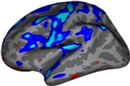
The statistical maps can be displayed on the template subject's surfaces, which can be used to visualize the spatially varying pattern of the thickness measurement variability.
thickdiffmap script
This downloadable script: thickdiffmap is a utility which wraps the four preceding steps into a single script. An example of its usage is:
set templsubj=(APN05T650_2)
set hemi=(lh)

rm -f resampled

./thickdiffmap APN01R650_4 APN01R650_5 $templsubj $hemi 1 2 3
./thickdiffmap APN02G650_4 APN02G650_4 $templsubj $hemi 1 2 3
./thickdiffmap APN03L650_3 APN03L650_4 $templsubj $hemi 1 2 3
./thickdiffmap APN04E650_2 APN04E650_3 $templsubj $hemi 1 2 3
./thickdiffmap APN05T650_2 APN05T650_3 $templsubj $hemi 1 2 3

./thickdiffmap unused unused $templsubj $hemi 4
Here, five subjects each have a pair of scans. One of the subjects, 'templsubj', is chosen as the common template subject to which the results are mapped. The file resampled is created during the 3'rd step, and contains the difference maps for the group (in this example, a group of five subject pairs).