|
Size: 2599
Comment:
|
← Revision 11 as of 2017-12-08 12:02:26 ⇥
Size: 3266
Comment:
|
| Deletions are marked like this. | Additions are marked like this. |
| Line 1: | Line 1: |
| ## page was renamed from mri_cor2label | |
| Line 9: | Line 10: |
| '''(formerly called mri_cor2label)''' |
|
| Line 10: | Line 13: |
| [[TableOfContents]] | <<TableOfContents>> |
| Line 14: | Line 17: |
| mri_cor2label - converts values in a COR volume to a label. | mri_vol2label - converts values in a COR volume to a label. (formerly called mri_cor2label) |
| Line 17: | Line 20: |
| mri_cor2label --c <cordir> --id <labelid> --l <labelfile> | mri_vol2label --c <cordir> --id <labelid> --l <labelfile> |
| Line 32: | Line 35: |
| || --surf subject hemi <surf> || interpret input as a surface overlay || || --sd subjectsdir || override $SUBJECTS_DIR || |
|
| Line 33: | Line 38: |
| = Outputs = | |
| Line 35: | Line 39: |
| ["mri_cor2label"] converts values in a COR volume to a label. The program searches the COR volume in directory 'cordir' for values equal to 'labelid'. The xyz values for each point are then computed assuming 1 mm^3 voxels and that xyz=0 at the center of the volume. The xyz values are then stored in 'labelfile' in the label file format; the vertex values are set to zero as is the statistic value. While this program can be used with any COR volume, it was designed to convert parcellation volumes, which happen to be stored in COR format. See tkmedit for more information on parcellations. The labelid must be within the range of 0 to 255. The label volume in mm^3 can be written to the argument of --v. |
mri_vol2label converts values in a COR volume to a label. The program searches the COR volume in directory 'cordir' for values equal to 'labelid'. The xyz values for each point are then computed assuming 1 mm^3 ^voxels and that xyz=0 at the center of the volume. The xyz values are then stored in 'labelfile' in the label file format; the vertex values are set to zero as is the statistic value. While this program can be used with any COR volume, it was designed to convert parcellation volumes, which happen to be stored in COR format. See tkmedit for more information on parcellations. The labelid must be within the range of 0 to 255. The label volume in mm^3 ^can be written to the argument of --v. == Note == The name of this program is a bit misleading as it will operate on anything readble by mri_convert (eg, mgz, mgh, nifti, bhdr, analyze, etc). |
| Line 48: | Line 46: |
| mri_cor2label --c /space/final/frontier/myparcellation --id 57 --l /home/brainmapper/spattemp/57.label | {{{ mri_vol2label --c /space/final/frontier/myparcellation --id 57 --l /home/brainmapper/spattemp/57.label }}} |
| Line 54: | Line 53: |
| ?? | Create a label of the left hemi surface vertices whose thickness is greater than 2mm. First, create a binarized map of the thickness: {{{ mri_binarize --i $SUBJECTS_DIR/subject/surf/lh.thickness --min 2 --o lh.thickness.thresh.mgh mri_cor2label --i lh.thickness.thresh.mgh --surf subject lh --id 1 --l ./lh.thickness.thresh.label }}} |
| Line 60: | Line 66: |
| ["tkmedit"], ["mri_label2label"] | [[tkmedit]], [[mri_label2label]] |
| Line 64: | Line 70: |
= Methods Description = NA = References = NA |
(formerly called mri_cor2label)
Index
Contents
Name
mri_vol2label - converts values in a COR volume to a label. (formerly called mri_cor2label)
Synopsis
mri_vol2label --c <cordir> --id <labelid> --l <labelfile>
Arguments
Positional Arguments
none
Required Flagged Arguments
--c <cordir> |
directory to find COR volume |
--id <labelid> |
0-255 value in COR volume |
--l <labelfile> |
name of output file |
Optional Flagged Arguments
--v <volfile> |
write label volume in file |
--help |
print out help information |
--synth |
synthesizes a label (ignores values in COR volume) |
--surf subject hemi <surf> |
interpret input as a surface overlay |
--sd subjectsdir |
override $SUBJECTS_DIR |
Description
mri_vol2label converts values in a COR volume to a label. The program searches the COR volume in directory 'cordir' for values equal to 'labelid'. The xyz values for each point are then computed assuming 1 mm3 voxels and that xyz=0 at the center of the volume. The xyz values are then stored in 'labelfile' in the label file format; the vertex values are set to zero as is the statistic value. While this program can be used with any COR volume, it was designed to convert parcellation volumes, which happen to be stored in COR format. See tkmedit for more information on parcellations. The labelid must be within the range of 0 to 255. The label volume in mm3 can be written to the argument of --v.
Note
The name of this program is a bit misleading as it will operate on anything readble by mri_convert (eg, mgz, mgh, nifti, bhdr, analyze, etc).
Examples
Example 1
mri_vol2label --c /space/final/frontier/myparcellation --id 57 --l /home/brainmapper/spattemp/57.label
This will load the COR volume found in the directory /space/final/frontier/myparcellation and then search the volume for values equaling 57. The results are stored in 57.label in the directory /home/brainmapper/spattemp, which must exist prior to execution.
Example 2
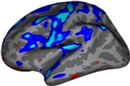
Create a label of the left hemi surface vertices whose thickness is greater than 2mm.
First, create a binarized map of the thickness:
mri_binarize --i $SUBJECTS_DIR/subject/surf/lh.thickness --min 2 --o lh.thickness.thresh.mgh

mri_cor2label --i lh.thickness.thresh.mgh --surf subject lh  --id 1 --l ./lh.thickness.thresh.label
Bugs
If the name of the label does not include a forward slash (ie, '/') then the program will attempt to put the label files in $SUBJECTS_DIR/subject/label. So, if you want the labels to go into the current directory, make sure to put a './' in front of the label.
See Also
Links
Reporting Bugs
Report bugs to <analysis-bugs@nmr.mgh.harvard.edu>