|
Size: 2033
Comment:
|
← Revision 7 as of 2013-08-13 10:17:13 ⇥
Size: 2102
Comment:
|
| Deletions are marked like this. | Additions are marked like this. |
| Line 3: | Line 3: |
| [[http://neuroimage.usc.edu/brainstorm/Introduction|Brainstorm]] is a collaborative, open-source application dedicated to MEG/EEG/sEEG/ECoG data analysis (visualization, processing and advanced source modeling). | [[http://neuroimage.usc.edu/brainstorm/Introduction|Brainstorm]] is a collaborative, open-source application dedicated to MEG/EEG/sEEG/ECoG data analysis (visualization, processing and advanced source modeling). |
| Line 5: | Line 5: |
| 1. Subject co-registration | Integration with Freesurfer (product of François Tade) includes the following: == Subject co-registration == |
| Line 7: | Line 9: |
| If you have been using the menu "Project sources" to calculate grand averages or statistics across subject, I recommend you read carefully the new coregistration tutorial: http://neuroimage.usc.edu/brainstorm/Tutorials/CoregisterSubjects |
If you have been using the menu "Project sources" to calculate grand averages or statistics across subject, it is recommended that you read carefully the new coregistration tutorial: * http://neuroimage.usc.edu/brainstorm/Tutorials/CoregisterSubjects |
| Line 10: | Line 12: |
| == Sub-cortical atlases == Now Brainstorm imports the subcortical atlas aseg.mgz as a set of surfaces, as part of the fully automated import procedure. More information on the FreeSurfer tutorial page: * http://neuroimage.usc.edu/brainstorm/Tutorials/LabelFreeSurfer |
|
| Line 11: | Line 16: |
| 2. Sub-cortical atlases Now Brainstorm imports the subcortical atlas aseg.mgz as a set of surfaces, as part of the fully automated import procedure. More information on the FreeSurfer tutorial page: http://neuroimage.usc.edu/brainstorm/Tutorials/LabelFreeSurfer |
== Cortical atlases and cortical regions == All the individual surface-based atlases generated by FreeSurfer are imported automatically. One new feature is the classification of those regions in macro-regions (pre-frontal, frontal, central, parietal, temporal, occipital and limbic), and the possibility to display those regions as colored areas on the brain. |
| Line 15: | Line 19: |
| == New anatomy templates == Instead of the MNI Colin27 brain, you can you the FreeSurfer average subject "FSAverage" as your default anatomy in Brainstorm, as well as the ICBM152 brain: * http://neuroimage.usc.edu/brainstorm/Tutorials/LabelFreeSurfer * http://neuroimage.usc.edu/brainstorm/Tutorials/TutFirstSteps (last section) |
|
| Line 16: | Line 24: |
| 3. Cortical atlases and cortical regions All the individual surface-based atlases generated by FreeSurfer are imported automatically. This have been around for a while, no breaking news. One new feature is the classification of those regions in macro-regions (pre-frontal, frontal, central, parietal, temporal, occipital and limbic), and the possibility to display those regions as colored areas on the brain. |
== Cortical thickness == The individual cortical thickness maps generated by FreeSurfer can be imported automatically as part of the automated import process. * http://neuroimage.usc.edu/brainstorm/Tutorials/LabelFreeSurfer |
| Line 19: | Line 28: |
4. New anatomy templates Instead of the MNI Colin27 brain, you can you the FreeSurfer average subject "FSAverage" as your default anatomy in Brainstorm, as well as the ICBM152 brain: http://neuroimage.usc.edu/brainstorm/Tutorials/LabelFreeSurfer http://neuroimage.usc.edu/brainstorm/Tutorials/TutFirstSteps (last section) 5. Cortical thickness The individual cortical thickness maps generated by FreeSurfer can be imported automatically as part of the automated import process. http://neuroimage.usc.edu/brainstorm/Tutorials/LabelFreeSurfer Other recent improvements http://neuroimage.usc.edu/brainstorm/News |
== Other recent improvements == * http://neuroimage.usc.edu/brainstorm/News |
Brainstorm
Brainstorm is a collaborative, open-source application dedicated to MEG/EEG/sEEG/ECoG data analysis (visualization, processing and advanced source modeling).
Integration with Freesurfer (product of François Tade) includes the following:
Subject co-registration
The projection of the source maps on the default anatomy, is now done using the registered spheres (?h.sphere.reg) from the FreeSurfer folder. The improves dramatically the quality of the subject co-registration. If you have been using the menu "Project sources" to calculate grand averages or statistics across subject, it is recommended that you read carefully the new coregistration tutorial:
Sub-cortical atlases
Now Brainstorm imports the subcortical atlas aseg.mgz as a set of surfaces, as part of the fully automated import procedure. More information on the FreeSurfer tutorial page:
Cortical atlases and cortical regions
All the individual surface-based atlases generated by FreeSurfer are imported automatically. One new feature is the classification of those regions in macro-regions (pre-frontal, frontal, central, parietal, temporal, occipital and limbic), and the possibility to display those regions as colored areas on the brain.
New anatomy templates
Instead of the MNI Colin27 brain, you can you the FreeSurfer average subject "FSAverage" as your default anatomy in Brainstorm, as well as the ICBM152 brain:
http://neuroimage.usc.edu/brainstorm/Tutorials/LabelFreeSurfer
http://neuroimage.usc.edu/brainstorm/Tutorials/TutFirstSteps (last section)
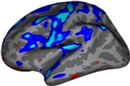
Cortical thickness
The individual cortical thickness maps generated by FreeSurfer can be imported automatically as part of the automated import process.